
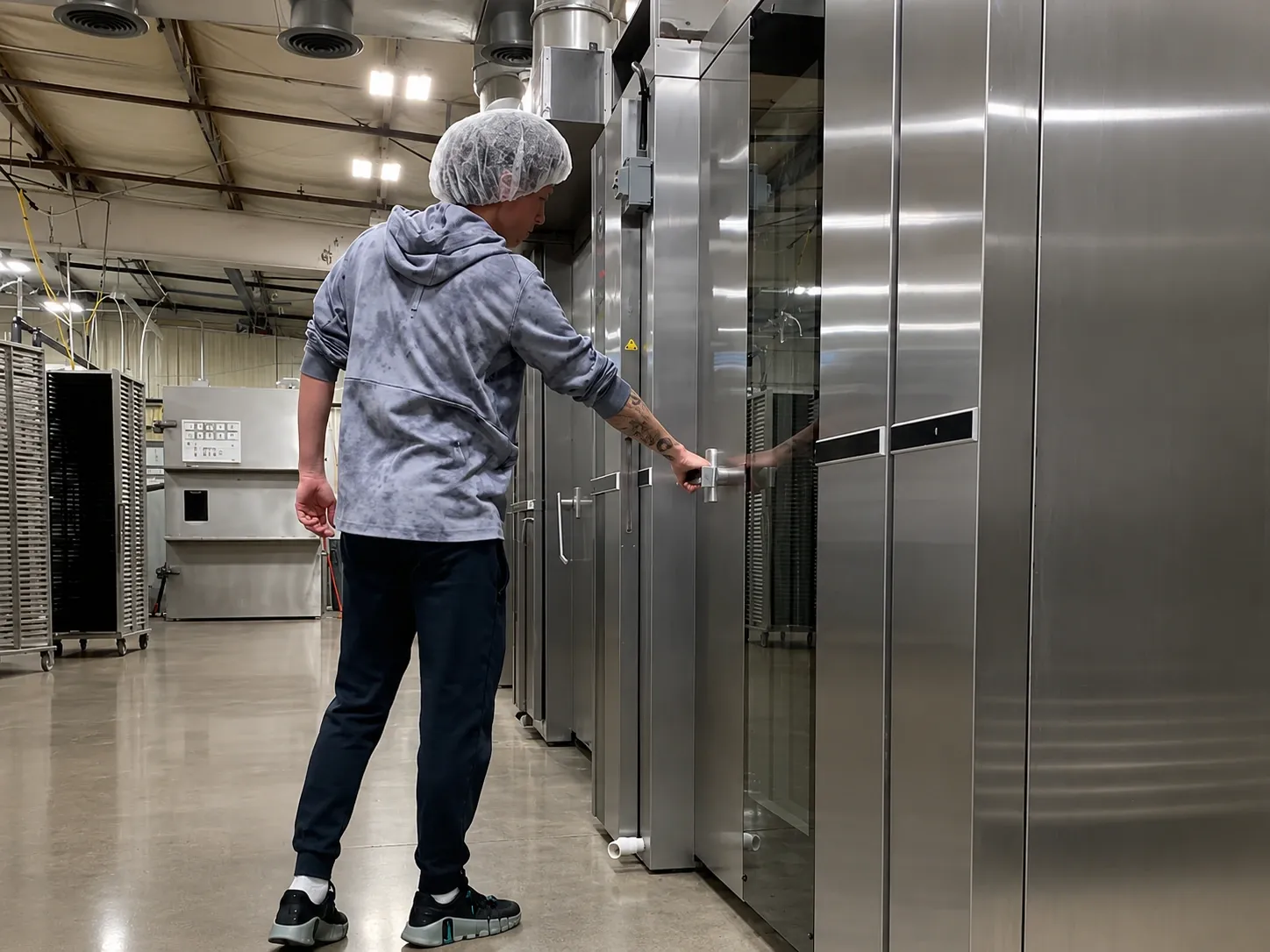
Hammer milling
The workhorse. Handles the bulk of the catalog and hits standard mesh specs consistently. Where most orders are milled.
The ecosystem
Gembra Health is the distributor. Flatiron Food Factory, our sister company, is the manufacturer, inspected under USDA or FDA as the program requires. Same ownership, same building, same standards.
Why it matters to you
A broker can send you a certificate. What a broker cannot do is tell you what happened to the material before it reached them, because they were not there when it happened.
We were. Freeze-drying, milling, and testing all happen at our sister company's inspected facility in Loveland, Colorado, ten minutes from the warehouse your order ships from. A question a broker would forward overseas, we answer in the same call.
The process

Material arrives as human-grade food rather than as pet-downgraded material. Production runs under USDA or FDA inspection depending on the program, and that first decision determines everything downstream: it is made before any processing happens.
Raw material is heat treated gently in commercial ovens. It comes out looking almost completely rare. There is no high-pressure step, no chemical bath, and no irradiation.
Material is frozen and the water is removed by sublimation. Freeze-drying is the gentlest commercial drying method available, and it is why we use it instead of spray-drying or heat-drying.
A hammer mill for most material, a cryogenic mill where a fine mesh or a high-fat material such as heart demands it, with a milling scientist on staff calling which. Density and mesh are set to your formulation, then held batch to batch.
Every order ships with a certificate of analysis, lab results, and a specification sheet. The certificate covers microbial, heavy metals, and water activity. Country-of-origin records and allergen statements are available on request, along with whatever else your file needs.
Finished material is warehoused in Loveland, Colorado for faster fulfilment to US and Canadian facilities, so lead time is not an ocean crossing.
In-house milling
Most freeze dryers in the country have no milling capability at all. They send dried material out to a separate co-packer who mills it, and that hand-off is where lot-to-lot drift is born.
The workhorse. Handles the bulk of the catalog and hits standard mesh specs consistently. Where most orders are milled.
For very fine mesh, for high-density requirements, and for high-fat material. Heart muscle is usually high in fat and normally requires cryogenic milling to reach a fine mesh at all.
Our sister company
The manufacturing side of the operation: freeze-drying, desiccation, milling, tolling, and procurement, under USDA or FDA inspection. If you need manufacturing rather than distributed material, they are who you want.
Everything else, buying finished powder by the kilo with a certificate of analysis and a quote, starts here. Orders begin at 10 kg per ingredient.
Buyer questions
Freeze-drying is the gentlest commercial drying method available. Material is frozen and the water is removed by sublimation, so the powder never goes through the heat of spray-drying or dehydration. The step that does the damage in this category is not drying, it is the kill step: high-pressure pasteurization paired with a chemical bath or irradiation. We use neither. Our raw material is heat treated at a minimum of 145°F for seven minutes, then freeze-dried and milled. Every order ships with a certificate of analysis, the lab results behind it, and the specification sheet, so the process is documented rather than asserted. Nutritional analysis is the one piece we assist with rather than supply, because the numbers depend on your finished formulation rather than on the raw lot.
That’s the point of milling in-house. We run both a hammer mill and a cryogenic mill with a milling scientist on staff, so we can hit a specific density and mesh and hold it across lots. High-fat material like heart usually needs cryogenic milling to reach a fine mesh at all. Most freeze dryers in the country have no milling capability and send material out to a separate co-packer, which is where lot-to-lot drift comes from.
HPP is the industry standard kill step, and it rarely runs alone. It is typically paired with a secondary step, usually a chemical bath or irradiation, and it is usually applied to FDA pet-downgraded raw material. We do not use it. Raw material is heat treated in commercial ovens at a minimum of 145°F for seven minutes, and higher where the program calls for it. The material comes out looking almost raw. It is not cooked: it is heat treated to the point that controls pathogens, and then it goes on to freeze-drying and milling.
Usually because it was high-pressure pasteurized. HPP leaves a powder with an odd, low bulk density that will not fill a capsule the same way twice, and that is what a fluffy or uneven lot on your line normally turns out to be. Inconsistent particle size does the same thing, and so does poor moisture handling, since organ powder is hygroscopic and cakes if it is not dried down or barriered properly. We do not use HPP. We mill in house to a density and mesh you specify and we can hold across lots, and water activity is on the certificate of analysis so the number is measured rather than assumed.
Tell us the mesh and density you formulate to. We’ll confirm feasibility, price, and lead time inside 12 to 24 hours.